

Industrial application of mold temperature controllers in die casting is to control mold temperature, ensure the quality of castings, improve production efficiency and extend the service life of molds.
The basic principle of MTC is to control the mold temperature and maintain stability through the circulation of heating or cooling media.
Because improper temperature control in die-casting can lead to defects such as shrinkage cavities, gas holes, and cold shuts.
In addition, MTC has more advantages over traditional methods such as gas heating, such as temperature uniformity and stability.
MTC has demonstrated irreplaceable value in addressing the demands of complex castings, reducing energy consumption and enhancing competitiveness.
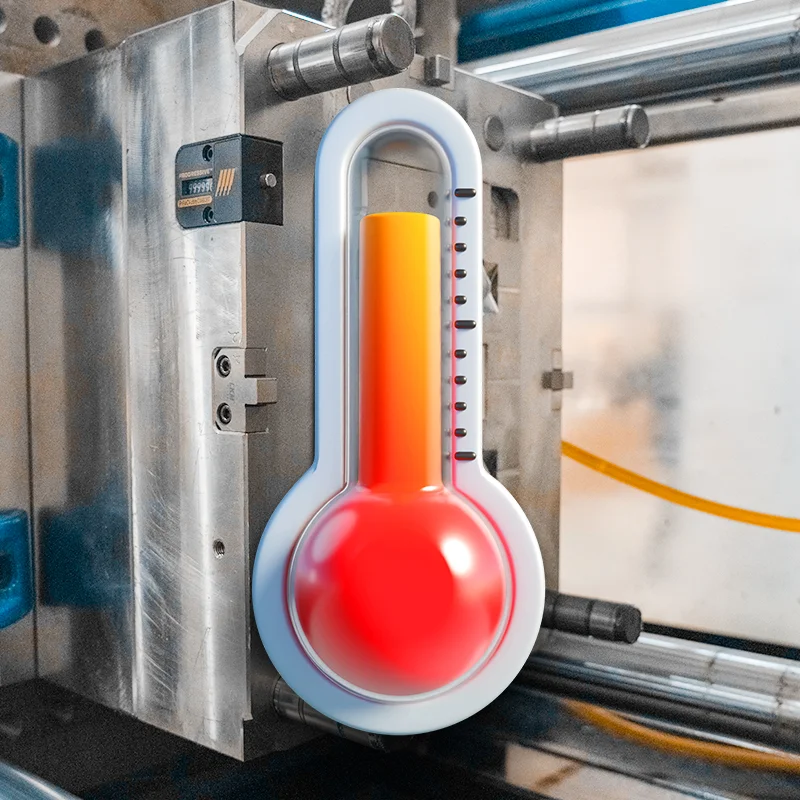
The application of MTC in Die Casting
Temperature control by material
The complex temperature control requirements of integrated die-casting
Special process support
Differential control of thin-walled and thick-walled parts
Temperature control by material
Aluminum alloy:
Working temperature 180-270℃, high-temperature oil circulation is required (up to 350℃) to achieve uniform heating.
Magnesium alloy:
It has a higher temperature requirement (180-300℃) and needs a high-temperature type MTC in combination with an indirect cooling system.
Zinc alloy:
Low-temperature requirement (100-200℃), suitable for water circulation MTC, temperature control accuracy ±0.5℃.
The complex temperature control requirements of integrated die-casting
Large castings (such as the front cabin size of 1.5m×1.0m) require temperature control through zonal division: the high-temperature zone utilizes oil at 320℃.
While the low-temperature zone employs water at 200℃.
Additionally, the system achieves thermal balance by integrating the machine-side cooling station.
The centralized control system (such as the Siemens WinCC platform) integrates multiple temperature control devices to achieve real-time distribution of flow, pressure and temperature.
Special process support
MTC indirectly controls the temperature through heat transfer oil (20-300℃) to prevent the mold from overheating and causing product deformation.
Differential control of thin-walled and thick-walled parts
Thin-walled parts require a higher temperature (250℃) to ensure fluidity, while thick-walled parts need a lower temperature (200℃) to accelerate solidification.